Coming to a free trade agreement with the EU should be "one of the easiest in human history" because our rules and laws are already the same, ~ Liam Fox international trade secretary.
|
|
Coming to a free trade agreement with the EU should be "one of the easiest in human history" because our rules and laws are already the same, ~ Liam Fox international trade secretary.
|
|

 |
| Derek Chauvin the cop that allegedly killed George Floyd |
Lee knows exactly who Jesse Washington was. His parents told him the story as a child. Lee has told it to his four children, and shown them the frightful pictures. “Future generations need to know what happened,” Lee says.Thousands of blacks were lynched, tortured, burned alive with Jesse Washington being just one of the many who were charged with various misdemeanors, some found guilty on the basis of very flimsy evidence and murdered in horrible ways. This would be a very, very long blog if I mentioned all of them in detail so I just picked three, two men one woman, they all died horrifically. Jesse was 17 and the date was May the 8th 1916 104 years ago.
In a nearby barbershop, the lynching is common knowledge. “Even today, you get caught up in the wrong place in Texas, you gone,” says Keith Pullens, 34, the shop owner. A conversation ensues about towns and counties to be avoided, lest a brother end up dying like James Byrd Jr., dragged behind a pickup truck by white supremacists in Jasper, 220 miles to the east, in 1998.
The verdict and death sentence were barely spoken when the mob surged forward, carried Jesse out the back door of the courthouse and dragged him to the square outside City Hall. The chain around his neck was flung over a tree. He was dangled above a large dry goods box filled with wood, which had been prepared earlier that morning.
While Jesse was still alive, “Fingers, ears, pieces of clothing, toes and other parts of the negro’s body were cut off by members of the mob,” the Waco Times-Herald reported. Someone castrated Jesse, according to the NAACP investigation, and carried his penis around in a handkerchief, showing it off as a souvenir.
The killers yanked Jesse into the air, then lowered him into the woodpile and poured coal oil over him. About 10,000 people crowded the area, according to the Waco Times-Herald, hanging from nearby windows and perched atop buildings and trees. “As the negro’s body commenced to burn,” the paper reported, “shouts of delight went up from the thou¬sands of throats.”
Jesse burned for two hours, leaving just a skull, torso and limb stumps. A horseman lassoed the body and dragged it through town until the head popped off. Some boys extracted Jesse’s teeth and sold them for $5 each. The headless mess was dragged behind a car to Robinson and hung in a sack outside a blacksmith’s shop, until a constable took it away that evening. Jesse was buried in an unmarked grave. https://theundefeated.com/features/the-waco-horror

Donald J. Trump 29 May at 06:10It's not a problem that is easily going to go away, especially when there are those that will fuel the fire to further an agenda. It basically relies on the really racist ones dying off over generations. A long process as children generally pick up on the parent's racialist ideals.
I can’t stand back and watch this happen to a great American City, Minneapolis. A total lack of leadership. Either the very weak Radical Left Mayor, Jacob Frey, get his act together and bring the City under control, or I will send in the National Guard & get the job done right. These THUGS are dishonoring the memory of George Floyd, and I won’t let that happen. Just spoke to Governor Tim Walz and told him that the Military is with him all the way. Any difficulty and we will assume control but, when the looting starts, the shooting starts. Thank you!
The men pursued Donald, attacked him and beat him with a tree limb. Hays wrapped a rope around Donald's neck and pulled on it to strangle him while Knowles continued to beat Donald with a tree branch. Once Donald had stopped moving, Hays slit his throat three times to make sure he was dead. The men left Donald's body hanging from a tree in a mixed-race neighborhood in Mobile. The tree was on Herndon Street, across from a house owned by Klan leader Bennie Jack Hays, the father of Henry Hays.Not just men either, the last woman to be lynched in the US was probably Mary Turner
According to accounts on the lynching, when Mrs. Mary Turner was brought the news of her husband’s lynching by “persons unknown,” she was eight months pregnant. Even though she was close to giving birth to her first child, she openly expressed the innocence of her lynched husband, cursed the mob, and threatened to obtain warrants for their arrest. Consequently, almost 100 years ago to the date, on May 19, 1918, she and her unborn baby became additional victims of the lynch mob’s wrath.
[The following contains graphic details of the lynching.]
Mrs. Mary Turner and her unborn baby experienced a horrific and unimaginable death. Mrs. Turner was bound and hanged from a tree, set on fire, and her body was riddled with bullets, her screams of terror and pain only to be heard by her perpetrators, and the torture and mutilation continued. The life of her unborn baby ended when the baby was crudely cut from her abdomen and one of lynchers crushed its head with the heel of his shoe. {link} (Just to reiterate Mary Turners crime was she expressed the innocence of her lynched husband, cursed the mob, and threatened to obtain warrants for their arrest.)

You should wash a face covering regularly. It can go in with other laundry, using your normal detergent.
CONCLUSION:
Our findings suggest that a homemade mask should only be considered as a last resort to prevent droplet transmission from infected individuals, but it would be better than no protection.
Conclusion
A protective mask may reduce the likelihood of infection, but it will not eliminate the risk, particularly when a disease has more than 1 route of transmission. Thus any mask, no matter how efficient at filtration or how good the seal, will have minimal effect if it is not used in conjunction with other preventative measures, such as isolation of infected cases, immunization, good respiratory etiquette, and regular hand hygiene. An improvised face mask should be viewed as the last possible alternative if a supply of commercial face masks is not available, irrespective of the disease against which it may be required for protection. Improvised homemade face masks may be used to help protect those who could potentially, for example, be at occupational risk from close or frequent contact with symptomatic patients. However, these masks would provide the wearers little protection from microorganisms from others persons who are infected with respiratory diseases. As a result, we would not recommend the use of homemade face masks as a method of reducing transmission of infection from aerosols.
Conclusions This study is the first RCT of cloth masks, and the results caution against the use of cloth masks. This is an important finding to inform occupational health and safety. Moisture retention, reuse of cloth masks and poor filtration may result in increased risk of infection. Further research is needed to inform the widespread use of cloth masks globally. However, as a precautionary measure, cloth masks should not be recommended for HCWs, particularly in high-risk situations, and guidelines need to be updated.
Critical shortages of personal protective equipment (PPE) have resulted in the US Centers for Disease Control downgrading their recommendations for health workers treating COVID-19 patients from respirators to surgical masks and finally to home-made cloth masks. The study found that cloth mask wearers had higher rates of infection than even the standard practice control group of health workers, and the filtration provided by cloth masks was poor compared to surgical masks. At the time of the study, there had been very little work done in this space, and so little thought into how to improve the protective value of the cloth masks. Until now, most guidelines on PPE did not even mention cloth masks, despite many health workers in Asia using them.
Health workers are asking us if they should wear no mask at all if cloth masks are the only option. Our research does not condone health workers working unprotected. We recommend that health workers should not work during the COVID-19 pandemic without respiratory protection as a matter of work health and safety
It is important to note that some subjects in the control arm wore surgical masks, which could explain why cloth masks performed poorly compared to the control group. We also did an analysis of all mask wearers, and the higher infection rate in cloth mask group persisted.
Finally for COVID-19, wearing a mask is not enough to protect healthcare workers – use of gloves and goggles are also required as a minimum, as SARS-CoV-2 may infect not only through the respiratory route, but also through contact with contaminated surfaces and self-contamination.
Governments and hospitals should plan and stockpile proper disposable products such as respirators and surgical masks to ensure the occupational health and safety of health workers. This appears to have been a failure in many countries, including high income countries.
An improvised face mask should be viewed as the last possible alternative if a supply of commercial face masks is not available, irrespective of the disease against which it may be required for protection. Improvised homemade face masks may be used to help protect those who could potentially, for example, be at occupational risk from close or frequent contact with symptomatic patients. However, these masks would provide the wearers little protection from microorganisms from others persons who are infected with respiratory diseases. As a result, we would not recommend the use of homemade face masks as a method of reducing transmission of infection from aerosols.
The evidence from these laboratory filtration studies suggest that such fabric masks may reduce the transmission of larger respiraory droplets. There is little evidence regarding transmission of small aerosolized particulates of the size potentially exhaled by asymtomatic or presymtomatic indivuidulas with COVID-19.
Can face masks help prevent the spread of coronavirus disease 2019 (COVID-19)?
Yes, face masks combined with other preventive measures, such as frequent hand-washing and social distancing, help slow the spread of the disease.
So why weren't face masks recommended at the start of the pandemic? At that time, experts didn't yet know the extent to which people with COVID-19 could spread the virus before symptoms appeared. Nor was it known that some people have COVID-19 but don't have any symptoms. Both groups can unknowingly spread the virus to others.
In one study, a mask that used 16 layers of handkerchief fabric was able to filter out 63 percent of 300-nanometer-sized particles. (The coronavirus is between 50 to 200 nanometers in diameter.) But that mask was harder to breathe with compared with thick, tight-fitting N95 respirators, often used in hospitals, that can block minuscule particles. Wearing a cloth mask with that many layers would be uncomfortable and may “cause some to pass out,” the researchers wrote in the letter.
A cotton bandana was the least effective, followed by a woolen scarf, but a 600-thread-count pillowcase folded four times could filter out around 60% of the particles.
Other researchers have found that while pulling a t-shirt up over your nose and mouth will block less than half of the aerosols coming towards it, doubling and even tripling the layers of a cotton t-shirt fabric can dramatically improve things in an emergency. Other fabrics such as silk and polyester were also found to be surprisingly effective. Cotton flannel, felted wool and quilting cotton have been found to be particularly good at blocking ultrafine particles, and one study suggested that a single sock, when flat and pressed tightly against the nose and mouth, could also serve as a good emergency mask substitute.
Much like the disposable N95 and surgical masks, homemade varieties like these are really only good for one use before they need to be disinfected if you want to maximise their potential. The US CDC recommends routinely washing homemade masks. Hot water alone may not be enough – one recent study found the Sars-CoV-2 virus can survive temperatures of at least 60C. Fortunately, the oily envelope that encases coronaviruses can be pulled part by soap and household detergent.
But Mueller warns that all these alternatives cannot be seen as replacements for an N95 mask. “There is a very important question – for health officials to interpret from the data that we are collecting – about what level of particle filtration is 'safe enough'? It is unfortunate but true that in some cases people may be choosing between multiple imperfect options.”
What about homemade masks?
As NPR has previously reported, some research has shown that cotton T-shirt material and tea towels might help block respiratory droplets emitting from sick people — though it's not clear how much protection they provide.
Another study, of health care workers in Vietnam, found that use of cloth masks resulted in greater infection than either those wearing surgical masks or a control group, some of whom also wore surgical masks.
The World Health Organization (WHO) currently says only two groups of people should wear protective masks, those who are:
Sick and showing symptoms.
Caring for people suspected to have coronavirus.
It says medical masks should be reserved for healthcare workers.
Masks are not generally recommended for the public because:
they can be contaminated by other people's coughs and sneezes, or when putting them on or removing them.
Frequent hand-washing and social distancing are more effective.
They might offer a false sense of security
But that doesn't mean they have no benefit at all for the general public - it's just that the scientific evidence is weak.
Homemade cloth face-coverings can help reduce the risk of transmission in some circumstances - they might help stop the spread of coronavirus by people who are contagious but have no symptoms (known as asymptomatic transmission).
The most protective mask is an FFP3 or, alternatively, an N95 or an FFP2. NHS staff in lower-risk situations can wear a surgical mask. This includes healthcare workers within one metre of a patient with possible or confirmed Covid-19. These staff may be in hospitals, primary care, ambulance trusts, community care settings and care homes.


“And when there is a risk that new diseases such as coronavirus will trigger a panic and a desire for market segregation that go beyond what is medically rational, to the point of doing real and unnecessary economic damage. Then at that moment humanity needs some government somewhere that is willing at least to make the case powerfully for freedom of exchange” - Boris Johnson
"I was at a hospital the other night, where I think there was a few coronavirus patients and I shook hands with everybody! you'll be pleased to know and I continue to shake hands" ~ Boris Johnson 3rd March 2020Inspirational and outstanding leadership in getting the message across....NOT. This isn't leadership this is pure childish incompetence.


Covid-19 strategies: Britain planned for herd immunity while Asia intended to contain virusWho got it right?
Britain had prepared for a herd immunity strategy to contain Covid-19, while other countries focused on enhanced testing capacity

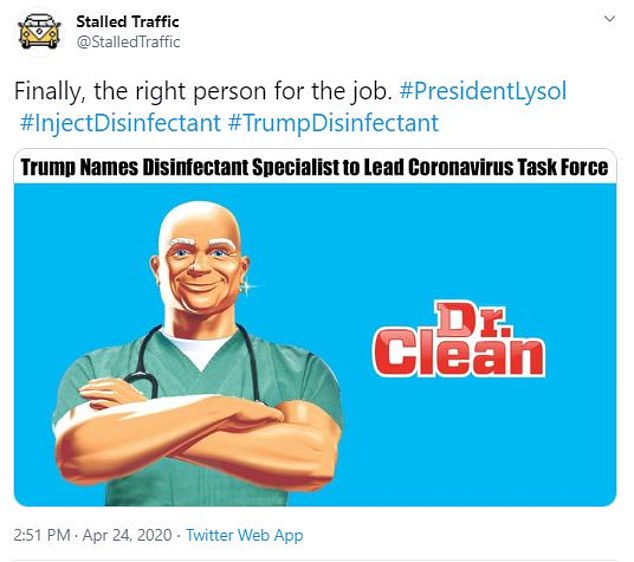
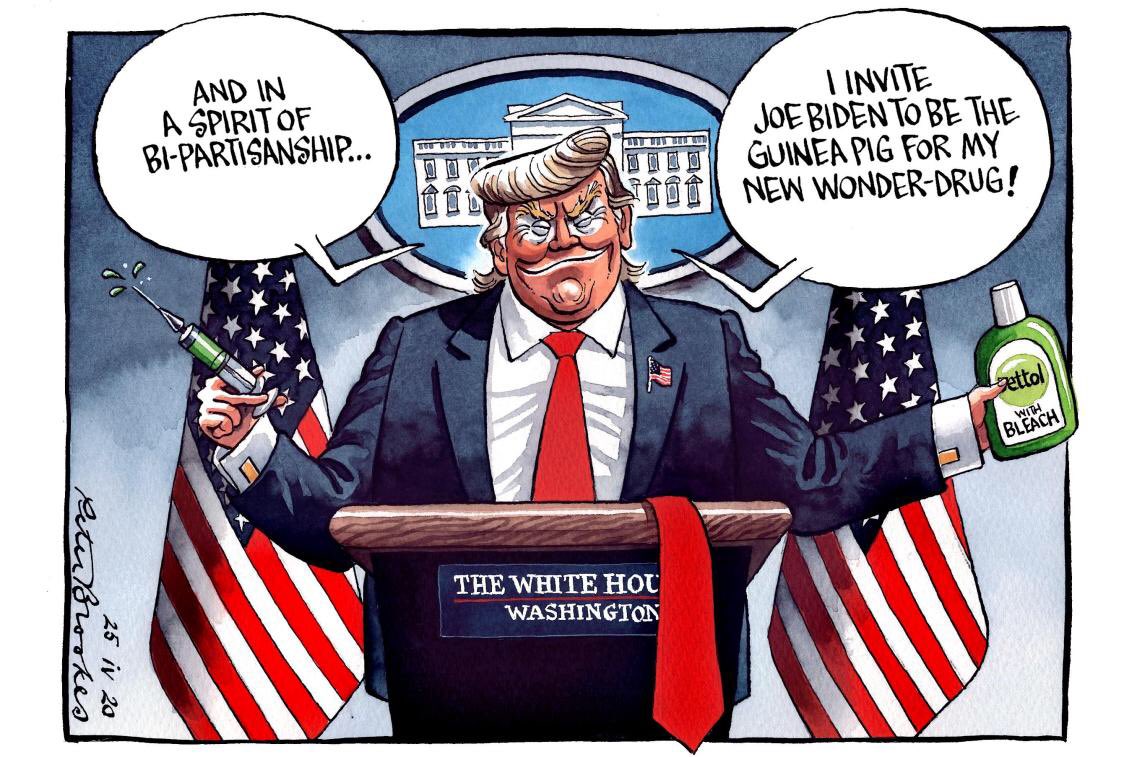
The President of the United States declared at a briefing yesterday:
‘and then I see the disinfectant, where it knocks out in a minute, one minute, and is there a way we can do something like that?’ - ‘By injection inside, or almost a cleaning. ‘Cos you see, it gets in the lungs, and it does a tremendous number on the lungs. So it would be interesting to check that.’ - 'So that your going to have to use medical Doctors with' - 'but it sounds interesting to me'So there is one thing on this disinfectant comment in the briefing. Regardless of what he said, whether he said it, whether he meant what everyone heard or interpreted it in the right way. (Then again things shouldn't be open to interpretation). One thing that cuts through all that crap.




 Nothing is as it seems.
23 March: The prime minister tells the UK public they "must stay at home". People are warned not to meet friends or family members they do not live with. Those with symptoms had already been told to self-isolate.27 March: Mr Cummings is seen leaving 10 Downing Street. "I suddenly got a call from my wife who was looking after our four-year-old child. She told me she suddenly felt badly ill." He went home, but after a couple of hours his wife felt better and he returned to work.Guidance: If Mr Cummings believed his wife may have had coronavirus, the guidance was that "all other household members who remain well must stay at home and not leave the house for 14 days".Evening: Mr Cummings went on to explain - "That evening I returned home and discussed the situation with my wife. She was ill. She might have Covid although she did not have a cough or a fever." Mr Cummings said many people he worked closely with, including the PM, had had symptoms or were absent with symptoms. He said: "I thought there was a distinct probability that I had already caught the disease."Later: Mr Cummings drove up to Durham with his family, arriving "at roughly midnight". "I was worried that if my wife and I were both seriously ill, possibly hospitalised, there was nobody in London we could reasonably ask to look after our child and expose themselves to Covid."My wife had felt on the edge of being able to look after him safely a few hours earlier." Mr Cummings did not say that at the point the family drove north his wife was unable to look after their child.Guidance: Stay at home is the simple government advice for households where one or more members have coronavirus symptoms. However, the main advice page says it is not always straightforward when children are involved. It says: "If you have children, keep following this advice to the best of your ability, however, we are aware that not all these measures will be possible."Other government advice did not contain this caveat, such as the leaflet drawn up at the end of March to be sent to every house. Nor did the government page on essential travel which said: "Essential travel does not include visits to second homes... whether for isolation purposes or holidays. People must remain in their primary residence."
- What are the lockdown rules for caring for children?
- Coronavirus: Can it affect eyesight?
- Kuenssberg: Questions remain
28 March: Mr Cummings says he woke up "in pain and clearly had Covid symptoms, including a bad headache and a serious fever".30 March: A No 10 source confirmed Mr Cummings had developed symptoms of the virus and was self-isolating "at home".1 April: Durham Constabulary speak to the father of Dominic Cummings who confirms that his son and family were present at the property.2 April: During the night, Mr Cummings' four-year-old son "threw up and had a bad fever". Following medical advice, an ambulance took the child to hospital. He was accompanied by Mr Cummings' wife. Mr Cummings "could barely stand up".3 April: After being taken to hospital, Mr Cummings' son woke up the next day having recovered. He was tested for coronavirus and his mother, who was with him at the hospital, was told "they should return home". According to Mr Cummings, there were no taxis so he "drove to the hospital, picked him up and returned home". He said he "did not leave the car or have any contact with anybody on this short trip". But according to his wife's later article in the Spectator Mr Cummings had a high fever and muscle spasms in his legs throughout this period.Guidance: People with symptoms that may be caused by coronavirus and who do not require hospital treatment are told they "must remain at home until they are well". General NHS guidelines on being discharged from hospital say: "If you're being discharged, arrange for a relative or friend to collect you, or let the staff know if they need to make other transport arrangements for you."6 April: At some point in the week leading up to this date, Mr Cummings discussed his decision to travel to Durham with the prime minister. "When we were both sick and in bed," he said, "I mentioned to him what I had done. Unsurprisingly given the condition we were in, neither of us remember the conversation in any detail."4-11 April: Mr Cummings said "after I started to recover, one day in the second week, I tried to walk outside the house". He confirmed he, his wife and his son went for a walk into woods owned by his father and it was at this point he was seen by passers-by but his family "had no interaction with them". The exact date is not clear but his second week isolating in Durham would have between these two dates.Guidance: Advice concerning outdoor exercise changed during the second week in April, when Mr Cummings and his family walked in the woods. Until 9 April, people with coronavirus symptoms and their household were told they could exercise outdoors. On that date, the advice changed to say "any exercise should be taken within your home".11 April: Believing he had recovered by this date, albeit "feeling weak and exhausted", Mr Cummings said he "sought expert medical advice". "I explained our family's symptoms and all the timings and asked if it was safe to return to work on Monday or Tuesday, seek childcare and so on. I was told that it was safe and I could return to work."12 April: Mr Cummings drives to Barnard Castle, about 25 miles from his parents' home in Durham, with his wife and child. He explained this episode as needing to test his driving was fine before making the long drive back to London. He said he'd been having problems with his vision.Guidance: The 1988 Road Traffic Act says: "If a person drives a motor vehicle on a road while his eyesight is such (whether through a defect which cannot be, or one which is not for the time being, sufficiently corrected) that he cannot comply with any requirement as to eyesight prescribed under this Part of this Act for the purposes of tests of competence to drive, he is guilty of an offence." The Highway Code says: "You MUST report to the Driver and Vehicle Licensing Agency (DVLA) any health condition likely to affect your driving."Sir Peter Fahy, former chief constable of Manchester Police, said the drive to Barnard Castle was potentially a criminal offence. "It's not the way to test your eyesight and put, potentially, other people in danger." On Twitter, John Apter, chair of the Police Federation for England and Wales, said: "If you're feeling unwell and your eyesight may be impaired do not drive your vehicle to test your ability to drive. It's not a wise move."Michael Gove told the BBC: "Dominic's eyesight was good enough. That was the whole point of the journey, to determine that he could drive safely."13 April: Mr Cummings and his family travel back to London.14 April: Mr Cummings is seen in Downing Street for the first time since 27 March.19 April: Five days after being in London, The Observer and Mirror report that Mr Cummings is seen again in Durham by an unnamed witness. Mr Cummings says he did not return to Durham and that evidence on his phone proves this.Mr Cummings insisted he did not break the law, saying: "I believe that in all the circumstances I behaved reasonably and legally, balancing the safety of my family and the extreme situation in Number 10."He said "I don't regret what I did" and added that "the rules make clear that if you are dealing with small children that can be exceptional circumstances and the situation I was in was exceptional circumstances".

